Showing posts with label cheese. Show all posts

Monday, February 05, 2007

Cheese experiment, book Jean-Charles Karmann

Camembert, camelised Apple slices and grinded Wallnut with bred crumbs around it.

But... something is missing here...

I tried it and I have to make a few changes to adapt it to my taste, sorry Jean-Charles... nothing personal, I am just a begginer... your book is phantastic ! I try again and make sure I do it as you say exactly in your book, ok?

Monday, November 27, 2006

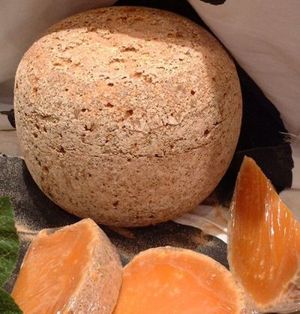
Mimolette Cheese

From Wikipedia:

Mimolette is a cheese traditionally produced around the city of Lille in northern France (where it is also known as Boule de Lille), and also in some areas of Belgium and the Netherlands (where it is also known as vieux Hollande).

A cow's-milk cheese, it normally weighs about 2 kg (approximately 4.5 pounds). Its name comes from "mollet". When young its crust is supple, but with age it becomes harder. It has a grey crust and orangish flesh. The orange color comes from the natural colorant Achiote.

The greyish crust of aged Mimolette is the result of cheese mites intentionally introduced to add flavor by their action on the surface of the cheese.

Mimolette can be consumed at different stages of ageing. Most cheese-lovers appreciate it most when "extra-old" (extra-vieille). At that point, it can become rather hard to chew, and the flesh takes a delicious hazelnut-like flavour.

Saturday, November 25, 2006

Queijo da Serra

from the wikipedia:

Serra da Estrela is a cheese from the region of Serra da Estrela, in Portugal. It is one of the most famous, not only in Portugal but also among appraiser all over the world. Its production has very rigorous rules and its delimited region is in the subdivision of the municipalities of Nelas, Mangualde, Celorico da Beira, Tondela, Gouveia, Penalva do Castelo, Fornos de Algodres, Carregal do Sal, etc. It is made of sheep milk, mostly during the months of November to March. Its maturation period has specific norms and must last thirty days at least. According to its maturation it becomes creamy pouring out or thicker. It is a cured cheese from artisan work with half-soft paste, creamy, white or slightly yellow, uniform (without holes or just a few) obtained from slow draining of curdled-milk, after raw sheep milk coagulation, with Cynara cadunculus thistle. The shape is a low cylinder with side camber and a little in the upper face, not having precise tacks. It shows a soft well formed rind, smooth and thin, with an uniform straw-yellow colour. Its scent is intense and the savour reveals a soft, clean "bouquet" lightly acidulous.

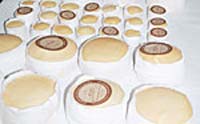
Saloio Cheese

from the wikipedia:

Saloio is a Portuguese cheese manufactured in the region between Lisbon and Sintra.

It is made from sheep's milk with no salt. It is a firm cheese usually served in small cylinders that are 5 cm wide and 6 cm high.

Another meaning of saloio is of a non-urban person, i.e. a person living outside the large city on the countryside whose behaviour is regarded somewhat uncivilized and foolish and thereby often being patronized by the hip urban sprawlers.

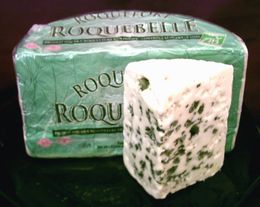
Roquefort Cheese

From the Wikipedia:

Legend has it that the cheese was discovered when a young shepherd, eating his lunch of curds, saw a beautiful girl in the distance. Abandoning his meal in a nearby cave, he ran to meet her. When he failed to catch her, he returned to his now moldy lunch and ate it out of pure hunger.

Roquefort, or similar style cheese, is mentioned in literature as far back as 79 AD, when Pliny the Elder remarked upon its rich flavor. Cheesemaking colanders have been discovered amongst the region's prehistoric relics.

Roquefort is a pungent ewe's-milk blue cheese from the south of France, and one of the most famous of all French cheeses. Though similar cheeses are produced elsewhere, European law dictates that only those cheeses aged in the natural Cambalou caves of Roquefort-sur-Soulzon may bear the name Roquefort, as it has a protected designation of origin. Roquefort is sometimes known as the "King of Cheeses", a distinction that is also used for the Italian Parmigiano Reggiano, the French Brie de Meaux and the English Stilton.

The cheese is white, crumbly and slightly moist, with distinctive veins of blue mold. It has characteristic odor and flavor with a notable taste of butyric acid; the blue veins provide a sharp tang. The overall flavor sensation begins slightly mild, then waxing sweet, then smokey, and fading to a salty finish. It has no rind; the exterior is edible and slightly salty. A typical wheel of Roquefort weighs between 2.5 and 3 kilograms, and is about 10 cm thick. As each kilogram of finished cheese requires about 4.5 litres of milk, Roquefort is high in fat, protein and minerals such as calcium.

Gouda Cheese


From the Wikipedia:

Gouda is a yellowish Dutch cheese named after the city of Gouda. The cheese is made from cow's milk that is cultured and heated until the curds separate from the whey. About ten percent of the mixture is curds which are pressed into circular moulds for a couple of hours. The moulds give the cheese its traditional shape. Next, the cheese is soaked in a brine solution which gives the cheese its rind and improves the taste. After the salt soaks in, the cheese is then dried for a couple of days before being coated to prevent it from drying out. It is aged for at least a couple of weeks before it is ready to be eaten. The term "Gouda" is now a generic name, and not restricted to cheese of Dutch origin. The term "Noord-Hollandse Gouda" is registered in the EU as a Protected Designation of Origin. The peculiar thing about this is that the city Gouda is located in the Dutch province Zuid-Holland. However, Gouda-type cheeses from Noord-Holland have a better reputation for their quality.

Exported Gouda is usually the young variety (aged between 1 and 6 months, rich yellow in colour and with a red or yellow paraffin wax coating). This cheese is easily sliced on bread with a cheese slicer. Exported Gouda has a pungent underlying bitterness, yet is still considerably creamier than other common cheeses, such as cheddar cheese, edam cheese. Locally, old Gouda (aged between 12 and 18 months, orange-yellow in colour and sometimes discernible by a black paraffin wax coating) can be obtained. This strong tasting cheese is hard and often too brittle to cut using a slicer, but it can be sliced by knife or served cut in cubes with drinks. Smoked Gouda is also a common find in many cheese markets and mega-marts.

Chefs at Home

Having a party with your good friends? Would you like to spoil them with amazing food? Staying in the Algarve region in Portugal? Ask for Amazing Chefs at Home